Now Reading: exploring raymond osrin’s legacy in cartooning
-
01
exploring raymond osrin’s legacy in cartooning


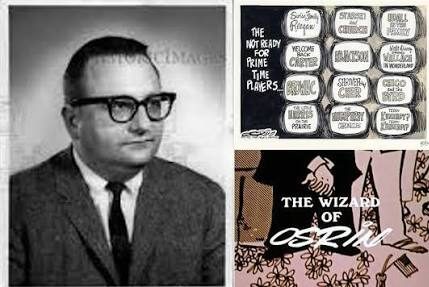

Raymond Osrin, a name synonymous with the golden era of cartooning, left an indelible mark on the world of illustration. Born in Brooklyn, New York, Osrin’s journey into the realm of cartooning began at an early age, fueled by a passion for storytelling and a keen eye for detail. His work has been celebrated for its wit, humor, and the ability to capture the essence of the human experience through simple yet profound illustrations.
Osrin’s career took off when he joined the Cleveland Plain Dealer, where he spent over three decades as a cartoonist. His tenure at the newspaper was marked by an era of significant social and political change, providing him with a rich tapestry of material to draw from. His cartoons were not just mere illustrations; they were a commentary on the times, reflecting the pulse of society with a sharp, insightful edge.
In the history of cartooning, Osrin’s contributions stand out for their unique blend of satire and empathy. He had an uncanny ability to distill complex issues into single-panel cartoons that resonated with audiences across the spectrum. His work often tackled pressing issues of the day, from civil rights to political scandals, with a deft touch that balanced critique with humor.
Osrin’s legacy is also notable for his influence on future generations of cartoonists. His style, characterized by clean lines and expressive characters, has inspired countless artists who followed in his footsteps.
- Education: Osrin studied at the School of Industrial Art and the Art Students League in New York City, leaving school as his cartooning career grew.
- Golden Age Comics: From 1945 to 1949, he worked as a staff inker at Jerry Iger’s comics shop, with 1940s credits appearing at publishers such as Fiction House and Fox.
- Graphic Novel & Strip Work: In 1950, he inked It Rhymes with Lust (published by St. John Publications), an early newsstand “picture novel”. His work also appeared in titles from Charlton Comics (including Blue Beetle and Crime and Justice) and Dell/Gold Key, alongside ghost-art work on the Morty Meekle daily strip in the 1960s. [1, 2]
- Newspaper Work: After doing television animation and industrial filmmaking in Pittsburgh, Osrin worked as a staff cartoonist for the Pittsburgh Press (1958–1963) before joining The Plain Dealer in Cleveland in 1963. He served as its main editorial cartoonist from 1966 until his retirement in 1993, winning a National Headliners Club award in 1971.

Related Posts
Stay Informed With the Latest & Most Important News
Previous Post
Next Post




Advertisement


-
 01The multifaceted career of Danny Winchell in the entertainment industry
-
 02Neil Sedaka’s Timeless Legacy Endures
-
 03John franco the history of his brooklyn and gravesend roots
-
 04New BrooklynEchoes.com Trivia Page
-
 05The History of Aida Turturro, Actress Born in Brooklyn,NY
-
 06The Rise of Alfred C. Drake in Theater and Music
-
 07The Early Career of James Van Patten and His Rise to Fame